
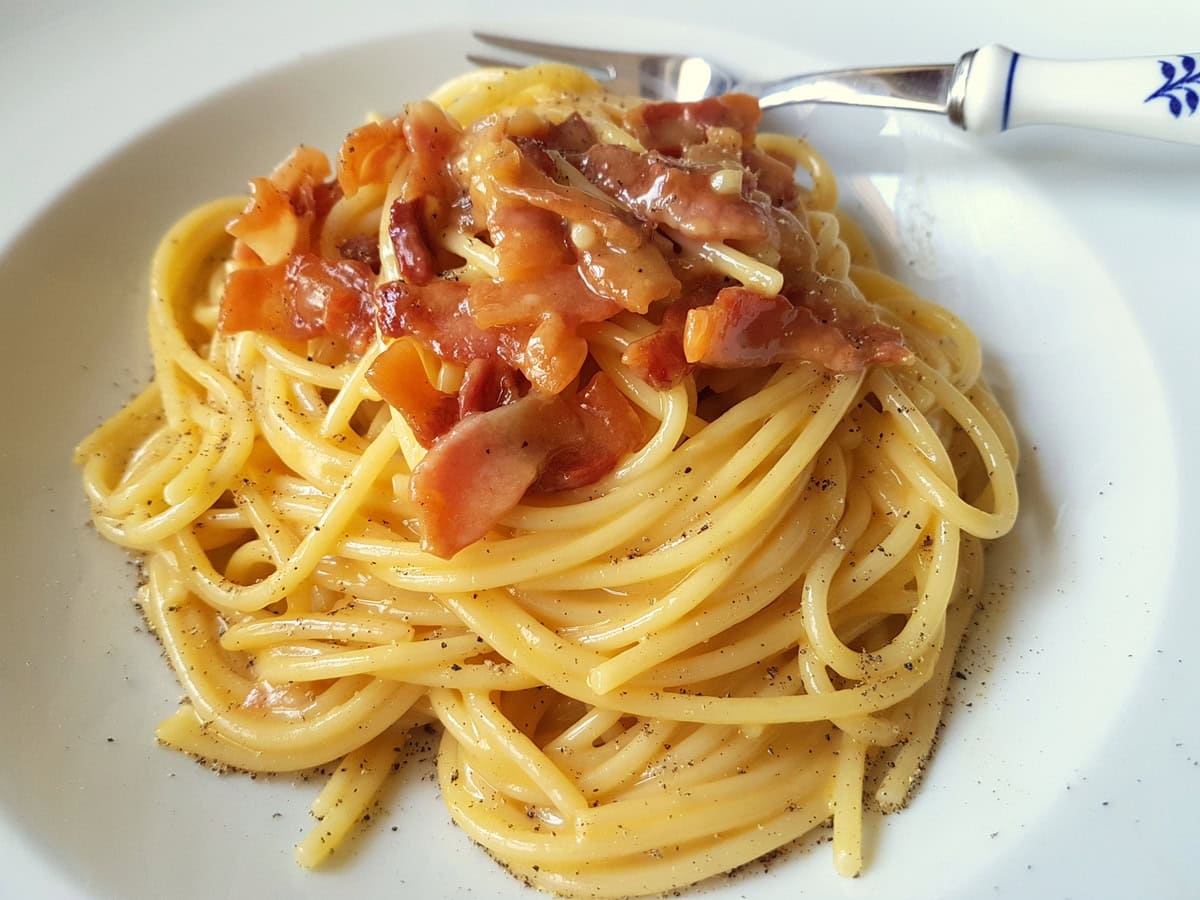
Spaghetti alla carbonara is probably 'the' most well known Italian pasta recipe. Well, maybe alongside spaghetti bolognese! And like spaghetti bolognese, it has been reinvented a thousand times outside of Italy. Of course, different versions of carbonara are good too. But the original authentic recipe really needs nothing added to it because it's delicious as is!

Some alternative alla carbonara history!
Like so many other Italian dishes, carbonara has a disputed history. The most commonly accepted theory is that it probably originated in or near Rome in the Italian region of Lazio. But how is the question!
First theory; It is believed that Umbrian coal men called ‘carbonari’ ate it themselves and introduced it to the Romans when they came to sell charcoal to them.
Theory no 2; It has also been said that carbonara was named for the ‘Carbonari’ a secret society in existence during the time of Italian unification (Dan Brown take note!)
Theory no 3, which I think has merit because carbonara recipes date only from the second war onwards, is that carbonara came from the demands of American soldiers stationed in Rome after the city’s liberation in 1944. Apparently, these soldiers supplied the Romans with bacon and eggs at a time when both were scarce.
How do Italians make spaghetti alla carbonara?
Whatever its origins, it's certain that alla carbonara has become a worldwide favourite pasta dish – although one that has many non-Italian versions!
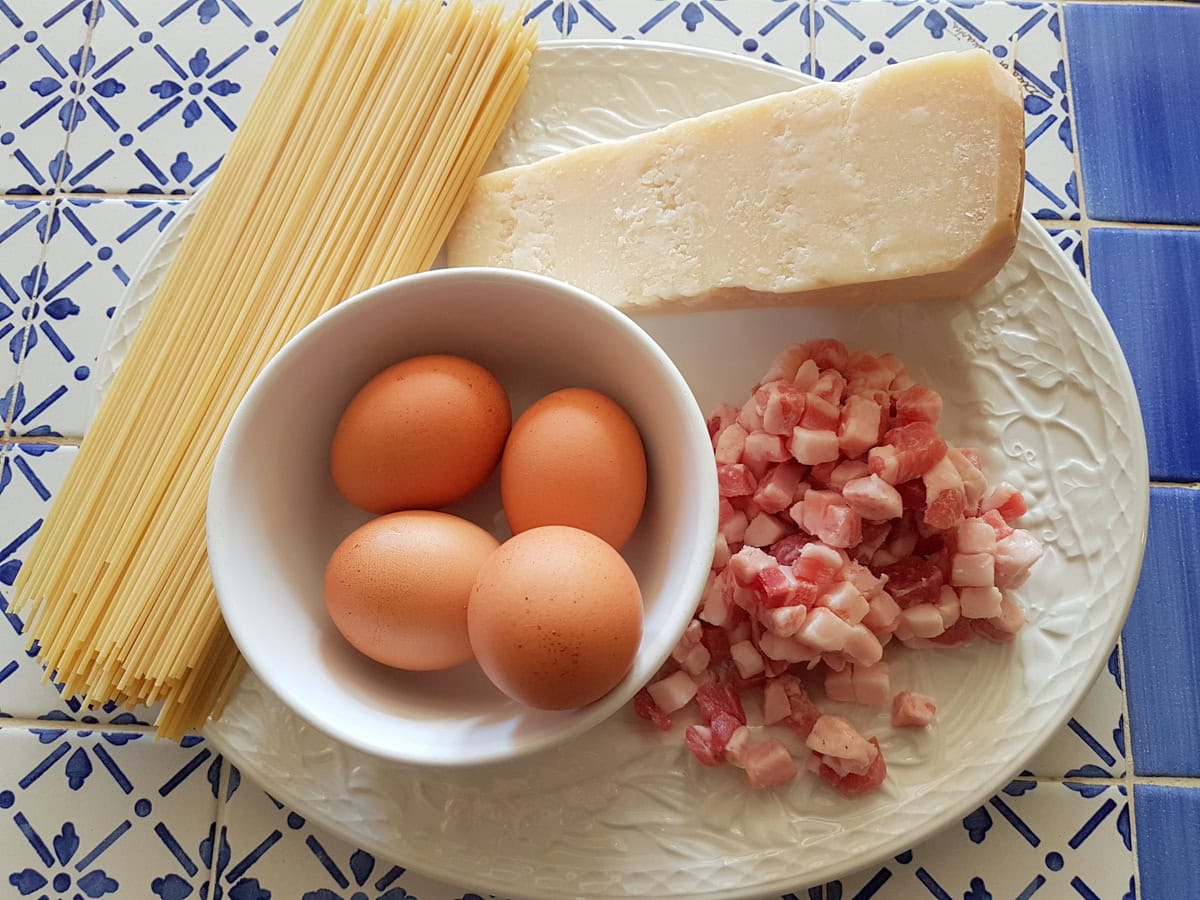
I have always called spaghetti carbonara ‘Italian bacon and eggs’ because basically that’s what it is; eggs, bacon, pasta, grated cheese and pepper. I think it’s the combination of bacon and eggs that makes this one of the most popular pasta dishes in the West, especially with the British and the Americans.
No vegetables! No cream!
Over time, traditional carbonara has been altered by the British, the Americans and others. I did a little experiment and searched through Instagram posts hash-tagged #carbonara. Needless to say, I found a zillion variations including ingredients such as cream (lots of cream, sometimes the pasta is swimming in it!), peas, leeks, broccoli, tomatoes and mushrooms.
It seems that these additions have become so common in America and England that it’s now considered the norm to make this dish with some kind of vegetable and cream. In Italy, it really isn’t!

Like many Italian pasta dishes, alla carbonara is a simple dish with few ingredients. But, it’s the quality of the ingredients and what you do with them that make the difference.
Carbonara ingredients.
Guanciale: The majority of chefs agree that 'true' pasta carbonara contains guanciale (cured pork cheek) and not bacon or pancetta. However, both make good substitutes if you can't find guanciale. Of course, the flavor will differ. Guanciale has a richer more intense flavor than pancetta. Guanciale renders quite a lot of fat so you don't need to cook it in olive oil.
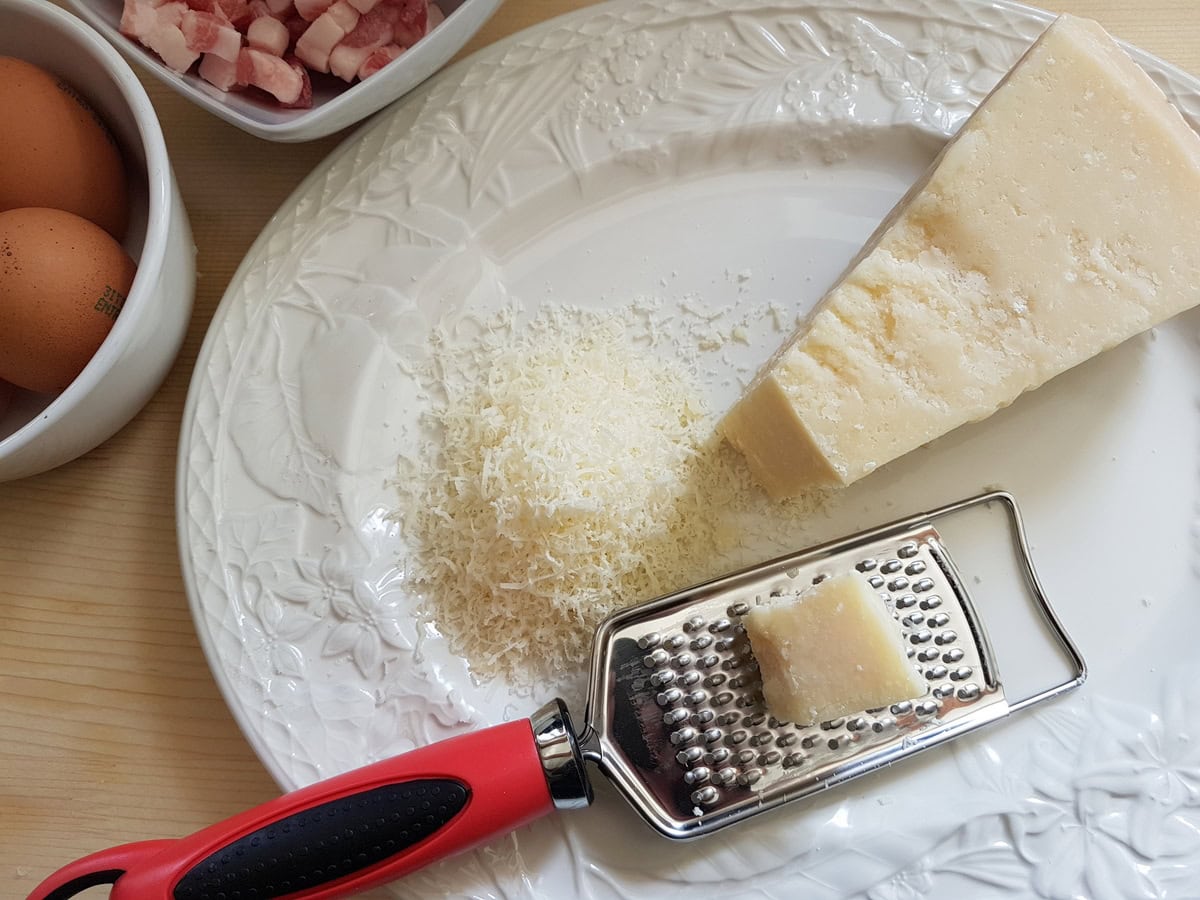
Pecorino Romano: Romans use their signature cheese, Pecorino Romano, for spaghetti alla carbonara. You can use Parmigiano instead if pecorino cheese isn't available but the flavor will be different. Pecorino is a hard cheese made from sheep's milk. It has a saltier and sharper flavor than Parmigiano (parmesan cheese). The latter is a cow's milk cheese which is quite nutty and sweet.
Eggs: Authentic spaghetti alla carbonara is made with egg yolks not whole eggs. The ratio is usually 1 egg per person plus an extra egg. So making carbonara for 4 calls for 5 eggs. Of course, it's possible to use whole eggs or a combination of whole eggs and yolks. However the 'sauce' is creamier and richer when you use just yolks.
Seasoning: Italians love to add a generous amount of freshly ground black pepper to their carbonara. Salt is used in the pasta water. But, less than normal as guanciale and pecorino are quite salty.
The pasta for carbonara.
Spaghetti is the usual pasta for alla carbonara. However, you can also use other long pasta like linguine, fettuccine and bucatini, or even rigatoni. In fact, Rigatoni is the second most popular pasta for carbonara in Rome.
Step by step instructions.
Preparation: Put a pot of water onto boil for the pasta. Add a little salt once it starts to boil and bring to a boil again. Cut off the rind of the guanciale and then cut it into cubes or strips.
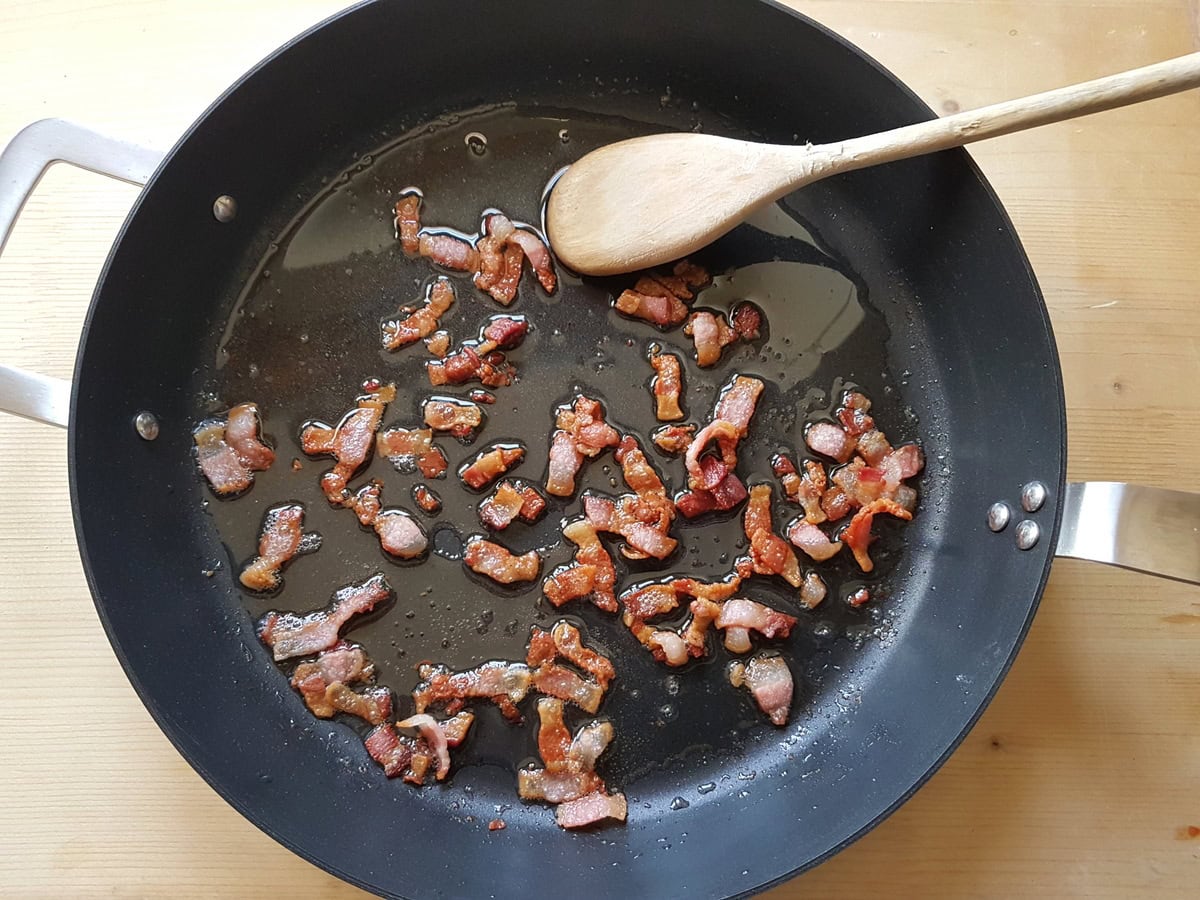
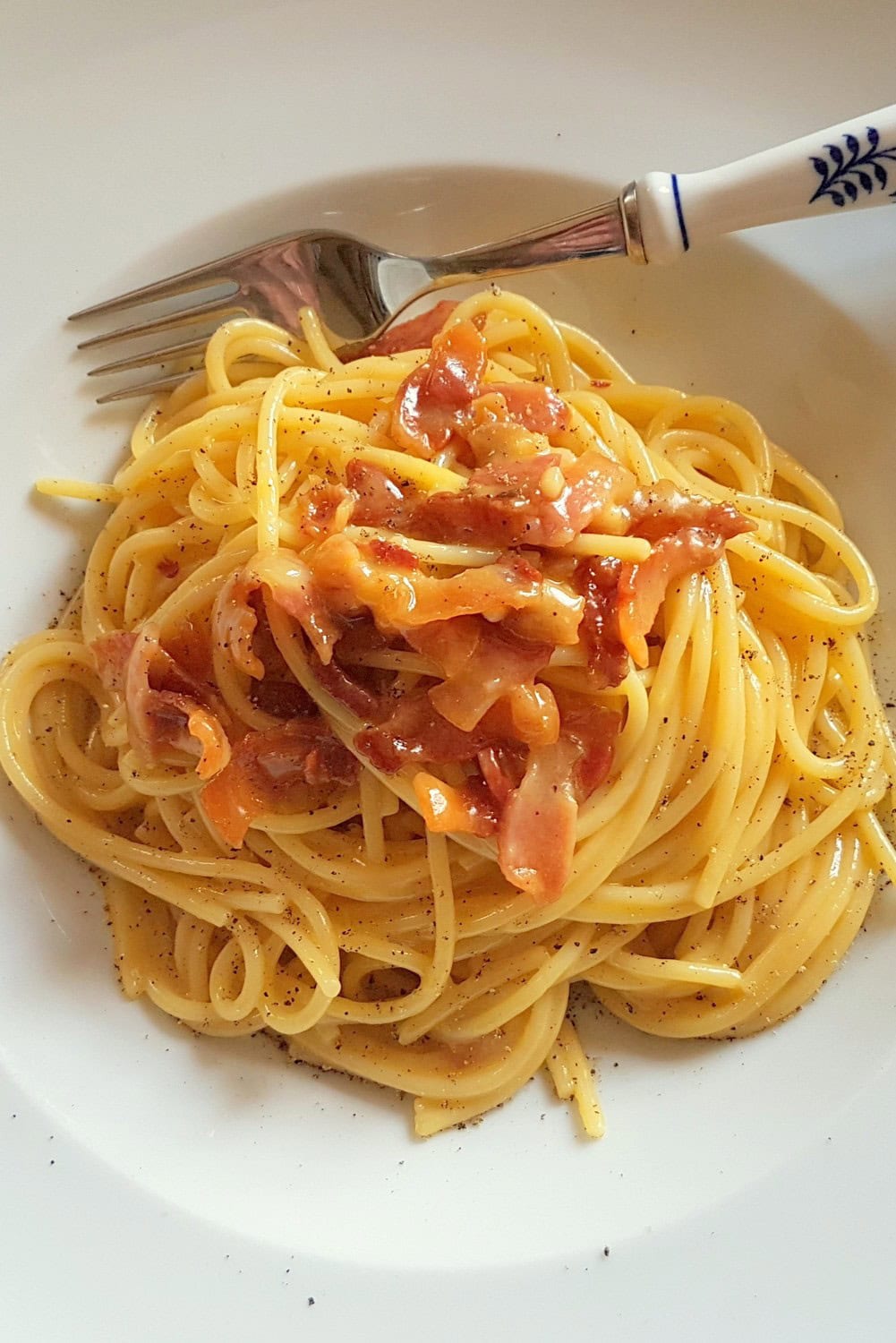
Step 1) Fry the guanciale in a large skillet over a medium heat until it becomes quite crispy. Guanciale renders a lot of fat so you don't need to use oil to cook it. Once it's crispy, remove the guanciale to a bowl lined with kitchen paper.
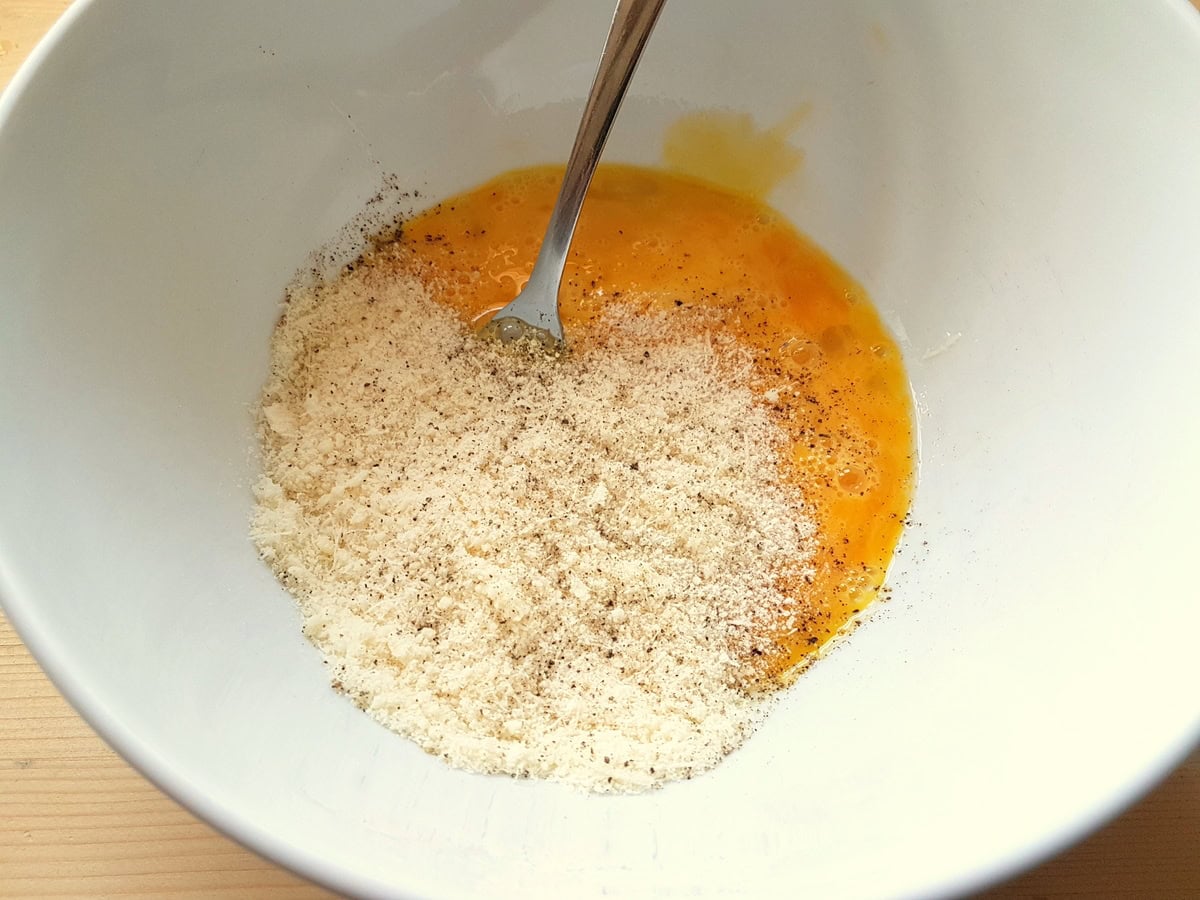
Step 2) Separate the egg yolks from the whites and put them in a large bowl. Beat the yolks until they are quite frothy, then add in the grated pecorino and some freshly ground black pepper. Beat everything together again before adding to the pasta.
Step 3) Cook the spaghetti until just short of al dente. Drain it and add it to the skillet where you cooked the guanciale after reheating the fat. Mix the drained pasta with the guanciale fat, add back most of the crispy guanciale and remove from the heat.
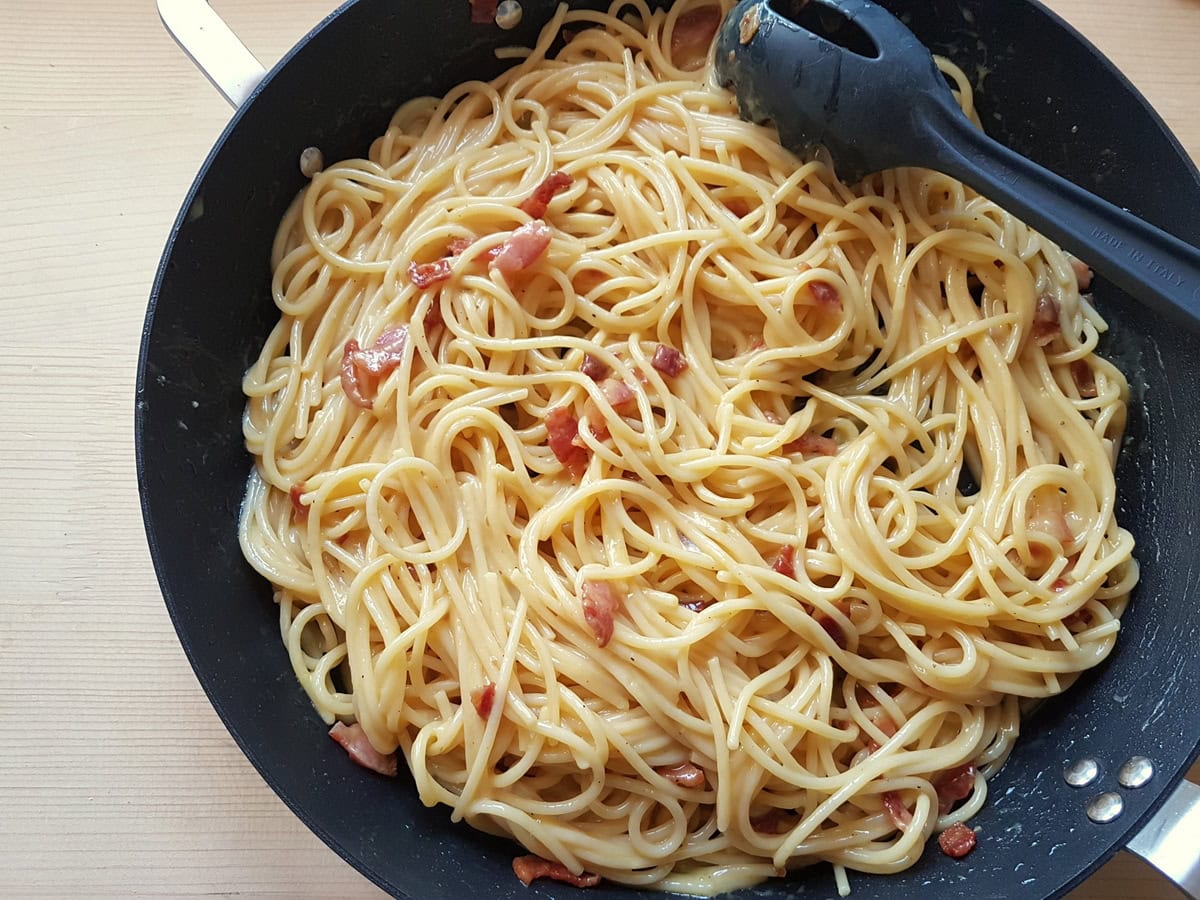
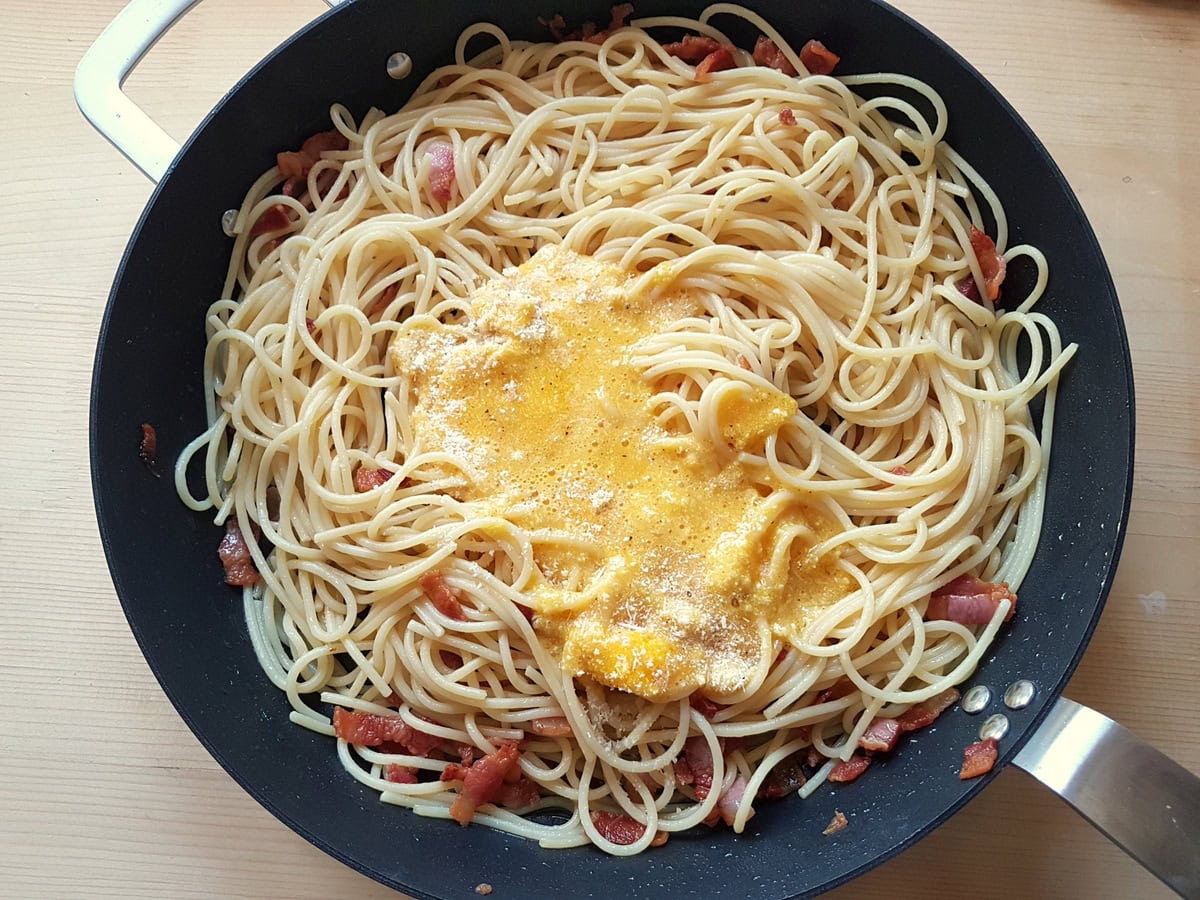
Step 4) Add the egg mixture to the spaghetti and guanciale. Mix everything together until the pasta is coated with the eggs and serve immediately.
Let me know what you think.
Even if you normally make your carbonara differently, it's worth trying it the Italian way! And, if you do try this classic Roman pasta dish, I’d love to hear what you think. Please write a comment here on the blog or post a comment on the Pasta Project Facebook page.
Your feedback means a lot to me!
Buon Appetito!
Other classic Roman pasta dishes to make.
- Pasta alla gricia
- Bucatini all'amatriciana
- Cacio e pepe
- Puntarelle pasta with burrata
- Romanesco broccoli pasta soup
- Pasta alla Papalina
(This recipe has been updated with new photos and text)
Save this recipe for later?
If you want to save this recipe for later, you can print it, bookmark this page or save it to Pinterest.
Spaghetti alla Carbonara

Ingredients
- 14 ounces spaghetti or spaghettoni You can also use rigatoni.
- 9 ounces guanciale (pork cheek) or pancetta (Italian bacon) cut into small cubes.
- 2 tablespoon olive oil (Don't use olive oil with guanciale)
- 5 egg yolks
- 7 ounces Pecorino Romano or Parmigiano
- freshly ground black pepper.
- salt for pasta
Instructions
- Put a pot of water on to boil for the pasta. Add a little salt once it starts to boil. Cook pasta a little less than al dente according to the instructions on the packet
- Meanwhile, fry the guanciale or pancetta until browned. (I use a little olive oil with pancetta but not with guanciale as it renders quite a lot of fat)
- Lightly beat egg yolks in a large bowl with the grated cheese and black pepper.
- When the pasta is ready, drain and add to the pan with the guanciale. Then mix well to coat the pasta. Take off the heat. Allow to cool slightly (so the egg won't be scrambled).
- Then add the egg and cheese mixture. Stir well to coat the pasta, but not too vigorously (you don't want scrambled eggs!). Serve immediately with more grated cheese and black pepper as required.
Notes
Spaghetti is the usual pasta, although linguine, fettucine, bucatini and rigatoni can also be used.
Nutrition
Pin for later
BRAYDEN STOCH says
I love the Penne Alla Carbonara with Mac and Cheese Balls it is very nice.
Jacqui says
I'm not sure what mac and cheese balls are Bryaden. But we do love alla carbonara!
joyce harris says
cannot find pancetta or guanciale without chemicals here(central Florida) I have used prosciutto and its good.
Jacqui says
Thanks for your feedback Joyce. Carbonara with prosciutto sounds like a delicious option to pancetta or guanciale.
Andrew says
Thank you for your amazing website. I am new to cooking but I love Italian food so I started my journey right here 🙂 I made the pasta exactly how you explained it here and the best part of it was actually al dente 🙂 So I managed that very well. However, as of the final dish - I think it ended up to be too dry. Now I understand why others add salads or cream - without those the dish is quite dry and it feels like something is needed to make it feel creamier. In any case, I read your description and I understand that no cream or salads should be used if you want to keep it original. Thank you for all those recipes, I love how easy it is to print them out for shopping and cooking offline.
Cheryl A Babcock says
add more pasta water if dry.
Lesley says
I'm eating it right now. Fabulous recipe! I'm going to impress my friends and family with this!!
Gloria says
This is Italian comfort food at the highest level. Simple ingredients make the most delicious dishes. You can never go wrong with bacon and pasta together.
Tony Marcantonio says
Your carbonara is similar to mine. I’ve used pancetta and guanciale. I do prefer it with guanciale. I transfer the almost al dente pasta directly to the pan with tongs. This adds some of the pasta water which makes the sauce creamier and aids the absorption. I place the pan over the pot of water to finish off the pasta.
Cindy R says
I had my first Carbonara in Florence and I could never get it correctly done in the USA. Everyone wants to put "cream and bacon" on it. Finally I made my own following your recipe and using pancetta. WOW WOW WOW - I'm back in Florence. I have some guanciale in the frig so I will try that next.
Love your blog!
michele says
This is such a satisfying dish. I used gunciale, cutting the rind off the block I got from my much appreciated local Italian supermarket. I made this at the specific request of a friend who is in in the midst of chemotherapy maze: this is what she really wanted to eat, and she loved it. Thank you for another easily accessible and well-explained recipe, with as always delicious flavour. And a particular thank you for giving my friend a pleasurable dinner.